Ekshef Postmortem

We don’t have that many startup postmortems coming from the middle east. Here is one.

Backstory

We started Ekshef in 2011 fresh out of college. I started it with other four co-founders. Our goal was to build an online booking service for doctors similar to what’s currently Vezeeta. The main motive for me was to solve the problem of finding and booking doctors, since I spent countless hours of my life in doctors’ clinics, and in my parents’ car while waiting for my turn.

We joined Flat6Labs cycle 0 (the very first cycle).  And after some ups and downs, we stopped working on Ekshef in 2013/2014. By the time of this writing, all the founders (with the exception of one) are outside of Egypt, and most of the people we worked with during that time are also currently outside of Egypt.

Since I have been getting some inquiries on what happened, and why it didn’t work. I decided to answer this once and for all. Before you proceed please note that this is my perspective, and other involved stakeholders might have different opinions.

Wrong Problem

We wasted a lot of time trying to solve the wrong problem. We thought if we solve the appointments problem for patients everyone would be happy. We realized that doctors don’t give a shit about organizing their appointments. In fact, some doctors even like having their clinics busy and full, because it is an indicator for many Egyptian customers of how popular – which means good – is this doctor.

We later realized the biggest pain for patients is actually finding out the good doctors. I still believe this is the main pain point in Egypt. People still ask their mom, their neighbor, or their friends for doctor recommendations. When we realized this we started building a social recommendations engine. The idea was you login to Ekshef using your Facebook account, then you would have two options 1) Recommend a doctor to your FB friends. 2) Ask for doctor recommendations. Back then, Facebook APIs allowed pulling all of the users’ friends (hello Cambridge Analytica). We were one of the beneficiaries of this feature and were using the social graph to help users recommend doctors to each other. This feature had moderate success, we could’ve optimized it more but we ran out of funding and lost hope before managing to get there.

Inexperience

We were naive and fresh out of college. We had a great technical team that could build anything. This led us to build a crazy search engine that would allow you to search for doctors with any way. Location, specialty, price, opening hours, you name it. To make it more crazy, I wasn’t satisfied by most of the services that provide Arabic search, including Vezeeta. Omar El Mohandes, who was working with us at the time and currently working at Amazon based in London implemented the Soundex search algorithm for Arabic. This algorithm allows you to search for any Arabic word without having to worry about the different versions the word. احمد = أحمد. Not only this, Omar did some improvements to make it detect typos. Yes, typos in Arabic names were still getting you the right doctor on Ekshef. Just like Google.

Another side of inexperience was dealing with those outside the company. We believed a lot of people that were lying to us. We had to no experience how to raise funds, and even our investors were inexperienced as much as we were with how the model should work. The general push was towards fund raising, but the company wasn’t really funding ready. The fund raising was based on totally unrealistic financial models that make no sense for a pre-market fit, pre-revenue company. We didn’t know it, our investors didn’t know it, and the people we were trying to raise funds from didn’t know it. It was like a group of blind people trying to identify the elephant in the room.

Wrong timing

When we started in 2011, internet and smartphone adoption wasn’t at the same level it is at now. Doctor assistants didn’t have smartphones. They didn’t know how to use a computer or the internet. Facebook and twitter weren’t as popular. People were downloading a game such as subway surfer by sending a 5 EGP message to get a link to the game on Google play store. And amidst all this, we were naively thinking the uneducated doctors assistants will use our system to organize appointments.

Add to this the political instability, and the fact that none of us had to stay and work in Egypt. We all decided one after another that it is not worth it, and everyone left to join a company abroad (Google, Amazon, Booking…etc).

Final Remarks

Ekshef experience shaped me in many ways. I have countless stories from these days. I met many great people that put their trust in me and helped me a lot. I have made good friends and was surrounded by some of the smartest people I know. I also had my flaws. I apologize for anyone I hurt or screwed up with. And I hope they forgive me.

As for my opinion on starting a startup in Egypt. I am extremely bearish on Egypt and don’t see it as a fertile ground for anything meaningful to come out of it.

There is a lot of inefficiency that makes any optimization problem impossible. There are basics that don’t exist such as logistics and payments infrastructure. There is an unavoidable brain drain that makes scaling an engineering organization super hard. And last but not least, building a successful company is a decade worth of effort with low probability of success, and with the current currency situation the economics don’t work compared to having a stable dollar/euro paying job abroad.

I hear you saying but look at Instabug and Wuzzuf. Those are exceptions to the rule. We are yet to find their final outcome. Even with the successes they have, they are at risk of losing everything and going back to zero. And still, those are exceptions in a country that’s failing by any objective measures.

I hope I am wrong.
Product Management Book Recommendations

Product management is interdisciplinary. There is strategy, tactics, communication, process, design, user research, engineering, data, analytics…etc. Each of those is a lever in the PMs arsenal of tools, and it is a topic on its own. Great PMs know how to use their highest impact levers to achieve the goals of the product they are managing.

My recommendation is to pick a few topics, and dive deep into them, while experimenting on the job with what each lever does and how can you get better at it.

Now to answer your question, here are a few books I read that are relevant to different topics/levers (Not sorted in any order):

  • Hooked: How to Build Habit-Forming Products >> Do you know that FB figured out in their early days that if a new user adds 10 friends in the first week, they don’t leave Facebook? This book is about what makes users stick, what goes into their minds, and what are the elements that drive this habit formation. The book is a bit overrated in my opinion (maybe because of all the buzz I see from its author), but it is worth a read.
  • Influence: The Psychology of Persuasion >> The book is mainly written for marketers in 1995, but If you want to understand the psychological tricks companies apply on users today (What if an ecommerce company show users the fastest selling items, creating a fear of missing out? How about some social proof from their FB connections? Or showing very expensive items next to less expensive ones to create a contrast effect, making the less expensive item being perceived as cheap?). This book is about those ideas.
  • Traction: How Any Startup Can Achieve Explosive Customer Growth >> If you want to understand what are the available growth channels and how to use each of them. Understanding growth is essential to building great products.
  • Lean Analytics >> For different metrics models related to different product types. What metrics are relevant for e-commerce? SaaS? Social Networks?..etc. By experience those will become natural to you, but if you are new to the topic or want to understand the bigger picture, this is a good start.
  • Cracking the PM Interview: How to Land a Product Manager Job in Technology >> Although it is written for those looking for a job, what I like is that different chapters cover different skills that are applicable to the PM job. I recommend reading it if you don’t know your biggest levers, it will open your eyes to some topics that you may not be fully aware of. One caveat though: If you are reading it to find a job, it is highly tailored to US companies processes and interview questions (Google, FB, Yelp…etc). If you are interviewing with European companies, the ideas and the questions might be a bit different.
  • Never Split the Difference: Negotiating As If Your Life Depended On >> Important for navigating tough stakeholders.

There is also this list which combines a few books I saw recommended by multiple people I trust.

Unpopular Opinion: Stop Patronizing Users

I think this is fine by Facebook. It can be considered a dark pattern, but it serves its goal which is getting as many users as possible past this screen.

Facebook is a company that prioritizes growth (signups, engagement, time spent…etc) above all else. They measure everything and they know what they are doing.

I expect they tested multiple versions of that page and found this version to lead to the highest acceptance rate, without hurting engagement or leading users to leave the service.

I deleted my Facebook account two years ago. My feed became too toxic because of what’s happening in Egypt. I felt way better after doing this and I encourage everyone I know who is going through some depressive episodes to do the same.

However, this is only my perspective, and it doesn’t make the wellness argument right (the argument that spending time on Facebook makes people feel worse).

One point that didn’t get enough attention in Mark’s EU hearing is when he mentioned that Facebook researched the wellness topic. He said one of their findings is that people feel worse if they mindlessly scroll through their feed watching news and videos. They feel better and less lonely if they see content from their connections. That’s why Facebook altered the news feed algorithm to show more of this content.

I don’t like the current tone in the industry that patronizes users by considering them unable to decide for themselves. There is some truth to this argument but it is a slippery slope if we start thinking we know what’s right for people.

The internet is an open space and people are able to decide what’s good for them. If you think you can do better, do it, otherwise stop patronizing others considering them stripped of their free will.

Bad execution: Google maps accessible routes

Google recently launched wheelchair accessible routes on Google maps. The feature is far from good.

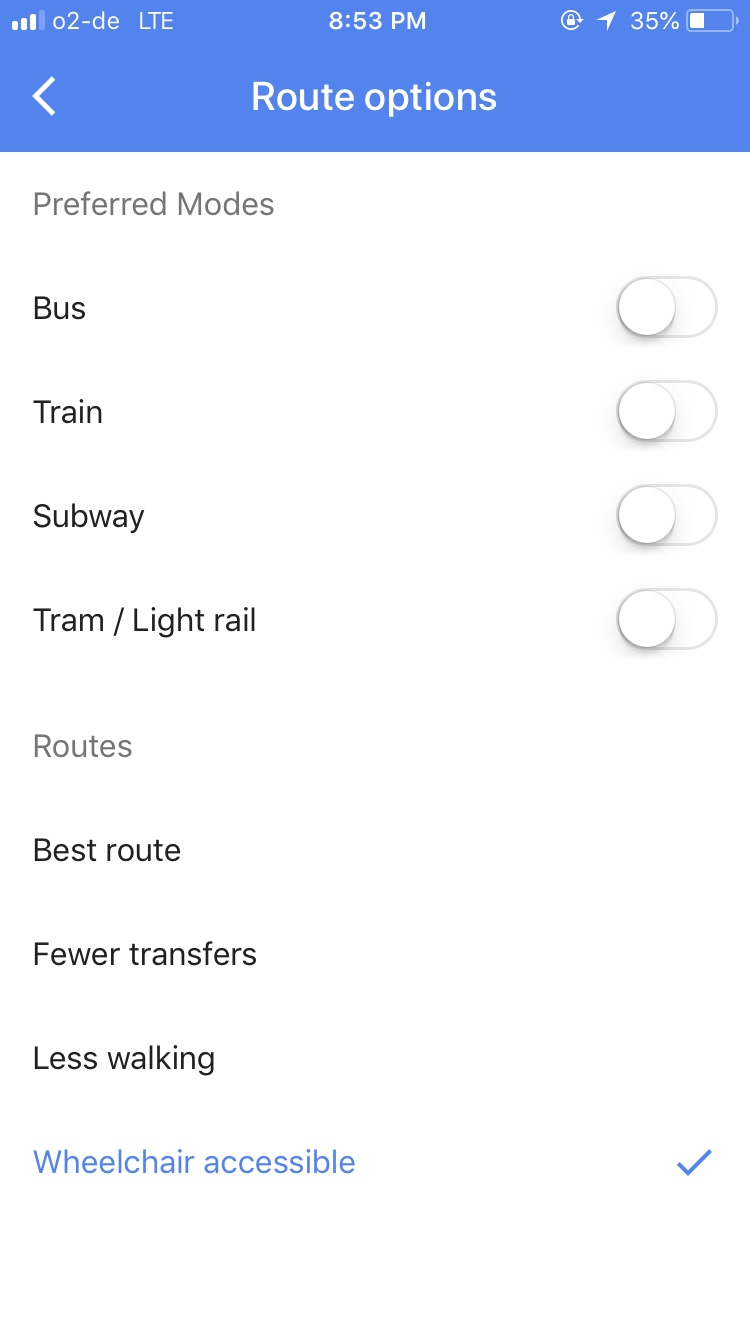
1- The data is inaccurate: I used it today in Berlin and it took me to a station with no elevator. I verified by cross referencing with the local app. And there is no obvious feedback mechanism.

2- The routing is weird: sometimes it shows me longer route with later arrival time.

3- The UX sucks: someone using the wheelchair accessible option is less likely to not use it the next time. I have to go to the options menu and choose wheelchair accessible with every search query. Why can’t this be a default option?

MarcoPolo App

I am surprised I didn’t blog about it although I am using it for close to a year. I heard of it from a press release that Benchmark Capital, the backers of Uber, Snap, and StichFix invested in it.

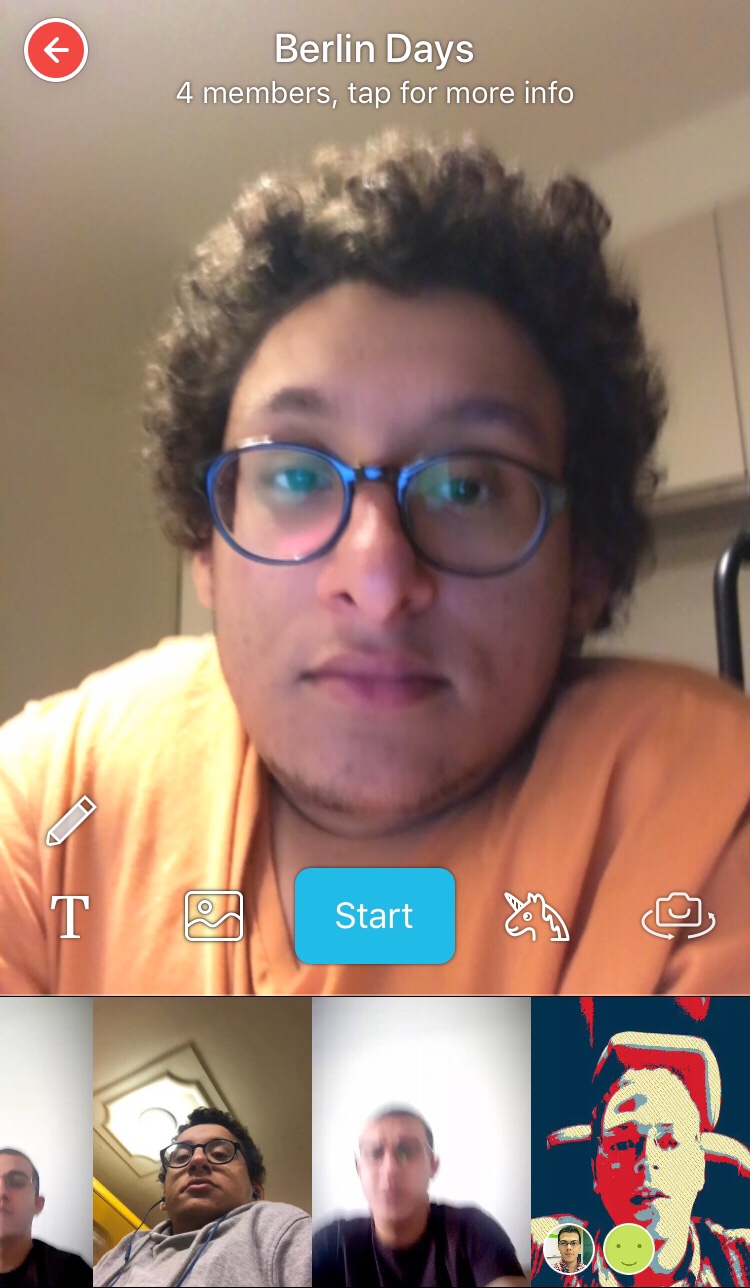
It is an asynchronous video messaging app. This solves a huge problem for me since currently my family, and all my friends live in different countries, with different time zones. It is hard to setup a time with all those people to sit and talk. MarcoPolo allows us to stay in touch.

Here is how it works:

  • You start recording a video.
  • Your friend/group receives a notification that you are recording a video.
  • They can go watch you live, or watch this message later when they see the notification.
  • They can record you a reply and you will get notified.

It is different from WhatsApp

  • You don’t have to tap and hold while recording.
  • There is no limit I faced on the length of the message.
  • Here is the best part: If you have no internet, or the internet is slow, it keeps working in the background until the full message is uploaded when you have a faster connection. This solves the problem of internet speed which forces us to schedule calls in places with fast internet, leading to the call not happening.
  • It only allow text on top of the video. No text chat interface.

Give it a try. Download it and message me. I am using my Egyptian mobile number on it. If you don’t have it, message me and I will send it to you.

Note: I took permission the people on those screenshots to show them on this post.

Blocking on YouTube

I don’t like Hussein Elgasmi. I blocked his channel on YouTube sometime ago thinking I won’t get his videos again. I was wrong.

As you see his channel is blocked, however I still got his latest video in my YouTube recommendations.

I am still getting Boshret Kheir in my autogenerated playlists. I always delete it when it is there.

It seems that blocking a channel and removing certain video/artist from your playlists aren’t strong enough signals for the YouTube recommendation algorithms.

I thought the former is a hard rule, not optional parameter for the algorithm. Maybe it is a bug, or no one thought of it.

The confirmation bias rational optimist

I tried reading “the rational optimist” by Matt Ridley. Here is a summary of the book chapters

  1. Stats and anecdotes showing the world got better.
  2. Stats and anecdotes from the next era showing the world got better.
  3. Stats and anecdotes from the next era showing the world got better.
  4. Stats and anecdotes from the next era showing the world got better.
  5. Stats and anecdotes from the next era showing the world got better.
  6. Stats and anecdotes from the next era showing the world got better.
  7. Stats and anecdotes from the next era showing the world got better.
  8. Stats and anecdotes from the next era showing the world got better.
  9. Stats and anecdotes from the next era showing the world got better.
  10. Some Pessimism: Africa is doomed, but it is gonna be alright. Climate change will kill us all if we don’t react to it, but it is also gonna be alright.
  11. Extrapolation of the stats and the anecdotes from chapters 1-9 to the coming 100 years.

The end

I am an optimist myself. It is the first word in my bio. But the book looks like it is written for optimists looking to support their confirmation bias. No wonder most of the people recommending it such as Bill Gates, and Naval are known to be optimists themselves.

I totally agree that the world got and is getting better. I keep telling everyone that someone like myself, born in Egypt fifty years before I was born, and have the same disease I have, would had far lower chance of living a comfortable life as the one I enjoy, let alone having a decent job and living by themself in a different country.

The book almost dismisses randomness and the role it plays in social, political, and economic boom and bust cycles. It forgets that the turkey after 1000 days of getting fed, it thinks tomorrow will be the same until thanksgiving comes.

It also dismisses the point, that individualization and capitalism, the same things that led the world becoming better, are making people unhappy feeling they lost their sense of belonging in the society, which on a longer run might have a reversal effect by people wanting this progress to stop. The book ignores that the rapid technological advancements are making tech and tech companies controlling humans more than ever, driving us towards a dystopian world where we become slaves of those technologies.

Those are just few points of pessimism – among many others – that I expected to be addressed in such a book. I expected it to have stronger arguments targeted towards real pessimists, and not a compressed dose of statistics and anecdotes that anyone could argue against, even if they are true.

Human Uniqueness

Someone asked me what’s unique about myself. I started my answer by saying “unique” is a strong word. There are 7 billion people on the planet so probably there are many people that can do the same things I do, or think the same way I think.

I gave it more thinking, the first thing that came to mind as unique is my fingerprints, then came the fact that actually my genetic combination is unique.

But the one thing that makes a human being really unique is their life journey. No two humans ever will have the exact same life journey. And the respective perception of each journey an individual lives is what gives life its meaning. That’s what make each individual “unique”.

My city is better than yours

An Egyptian friend asked me whether he should relocate to London or Berlin, and whether I know someone living in London that he can talk to.

Here is my answer, since every-time I sit with a group of Egyptians living abroad, they start comparing the cities they live in, and this is one of the most annoying discussions for me.

The problem with these questions is everyone will be biased to the city they live in.

You shouldn’t ask which is better, you should have specific parameters and judge based on them.

For example: Average salaries after taxes, accommodation costs, what differs if you are married/have kids?

Then there are more meta questions: Language. Ease of changing job (in terms of supply and visa). Citizenship if you are interested like how many years, does it require giving up the Egyptian, are you opposed to renouncing your Egyptian citizenship?

The salaries point is also rhetorical. As someone working in tech you are probably in the 90th percentile of the pay scale of any city in Europe. I have no data to back this claim, but at least I know it is the case in Berlin. I wouldn’t imagine London, or Zurich are any different.

It all comes down to answering a simple question: What are you optimizing for?